
Horarium
Ancient wisdom for today's pilgrims - creating balance in life day by day.


How we spend our days is, of course, how we spend our lives. What we do with this hour, and that one, is what we are doing.
Annie Dillard: The Writing Life
Is there a month more beautiful than June? I’ve been romping around Ireland where the roadside hedges are resplendent with wild fuchsia and the elderberry flowers are everywhere just waiting to be picked and simmered with lemons for a refreshing tonic.

Traveling is something I enjoy but it does take me away from my daily rhythms. Thus I’ve been neglecting my daily pages. Already this commitment to a monthly blog entry has suffered a setback. In fact, I’ve been neglecting many of my daily practices and, now that I’ve returned home, I feel unmoored and scattered.
You see, as I can be a bit of a free spirit, I do need structure in my day to channel that energy. I’ve learned the hard way to develop daily rhythms that ensure I make time for that which will rein in my worst proclivities, tend to my gifts, and listen deeply to life.
Horarium. It’s a weird word. Embedded within, as you may notice, is the word “hour”. One can walk into any monastery of a Benedictine or Cistercian tradition and find an horarium posted prominently. The horarium, or schedule, is the heartbeat of a monastic community. Most prominently, the times for praying the seven “hours” of the Liturgy of the Hours are noted for the community and for visitors as such prayers are generally open to the public. And, Benedictine houses are never without visitors.
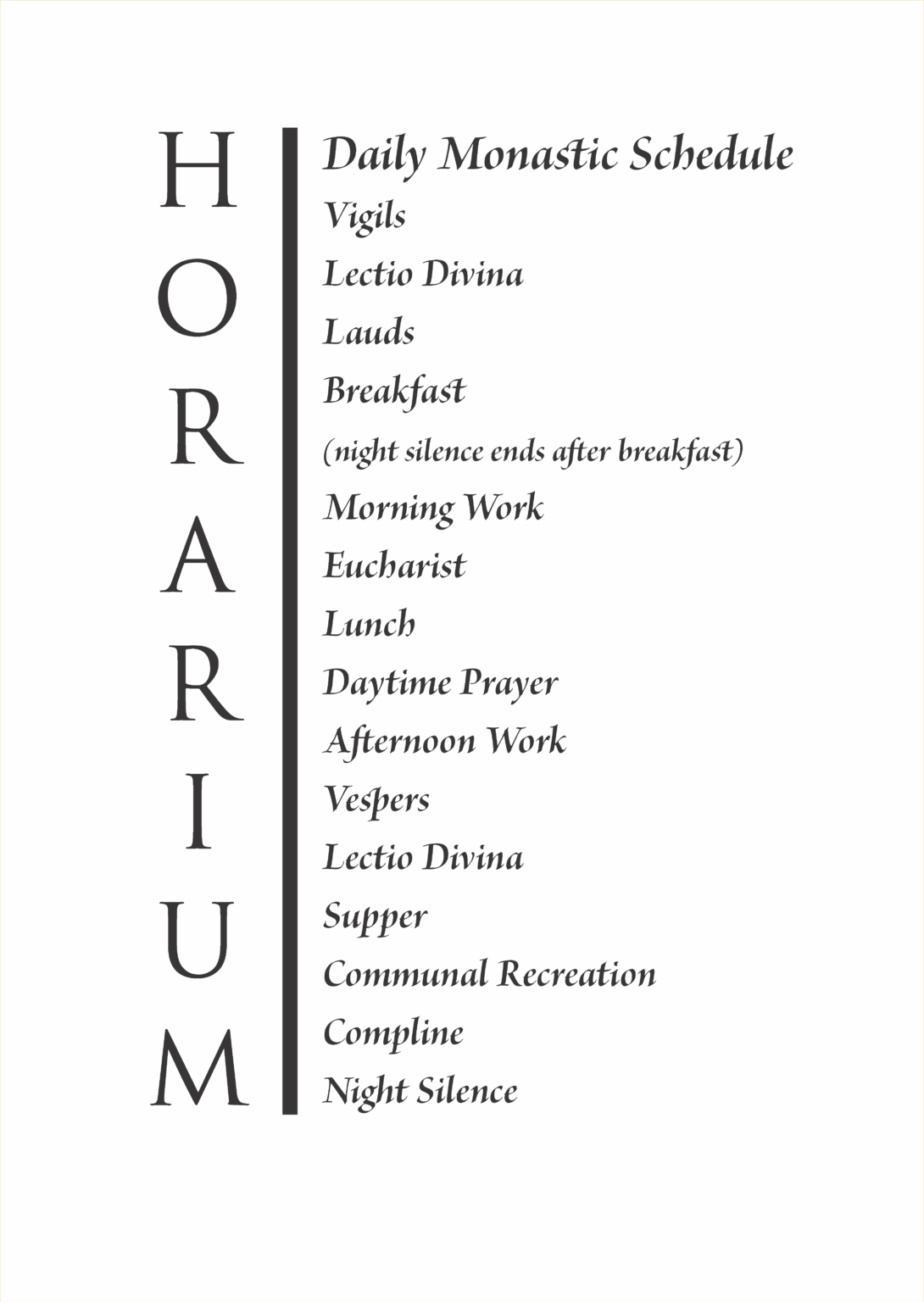
I don’t live in a monastery but I do strive to order my days - my hours if you will - in such a way that gives balance to that which sustains me. Not slavishly of course as life happens, but with a sense that I will not know who I am called to be if I am not making the time for those practices that enable me to hear the voice of God and that bring nourishment and growth. So, I have a personal horarium, if you will. It includes things like — prayer, time with family/friends/community, service, writing, yoga, reading/learning, a daily walk, an occasional bike ride, cooking/hospitality, gardening or knitting — as examples. I even strive to make time during the week to learn something new like playing the piano or writing haiku1. Keep those brain synapses going!
There is not room in every day for all of these examples but the non-negotiables for me are 1) something mystical (prayer/meditation), 2) something communal (family/friend/service), 3) something physical (yoga or a walk), 4) something intellectual (writing/reading/new learning), and 5) something creative (cooking, gardening, a craft).
Mysteriously, these are not separate and distinct nor do they function in dualistic ways. Each practice draws from and leads into another so that life becomes the embodied, organic whole I believe it is intended to be. I consider all of these to be contemplative practices in that each enables me to experience, in different ways, the many faces of the Divine who permeates all of life.
Jim Finley, a protégé of Thomas Merton, puts it this way:
At any given time we are likely to have not a single practice but rather a constellation of practices…. As the months and years go by the constellation changes. New practices emerge. Practices that have been present for years fall out of the picture…We discover by experience that if we are faithful to our contemplative practices, our practices faithfully lead us in the direction of a more daily, abiding awareness of the divinity of the life we are living. 2
Moreover - and I have learned this the hard way - it is the regularity or even dailiness of these non-negotiables that is formative for me. I can’t “catch-up” on the essentials on the weekend or some other less busy time. I share an anecdote that illustrates what I mean…
“Move the Bookmark”
For the past 5 years, I have been co-director for the oblate program of my monastic community. One of my responsibilities was to work with those individuals interested in becoming oblates3 with the community - a two year process. One fundamental aspect of his or her formation is for an individual to develop or deepen a daily prayer life and to read a short excerpt and commentary on the Rule of Benedict - a seminal text for monastics. I was in a zoom conversation with one of our Initiates in formation. He was lamenting that he was ‘way behind’ in his daily reading of the Rule and needed to catch up. He held up the book, showed me the book mark and the current page where he was ‘supposed’ to be. Indeed, there was a gap. My response was to ask him to move the bookmark to the current day. A conversation ensued about embracing the present moment, noticing what is before us now, and living today.

None of us, I suspect, no matter how much we try to be faithful, are perfect when it comes to our daily practices. So, “Move the Bookmark” has become a metaphor for me when I find myself sliding. I acknowledge the lack of faithfulness and, with grace, begin again. That’s where I find myself these days.
I returned home from Ireland to the same lush greenness. I noticed the roses blooming as the iris exit center stage and the astilbe wait in the wings for their moment. Like the ebb and flow of the tides, plants teach me about faithfulness and authenticity. The elderflower appears in June; the berries in the Fall — and it does not try to be a rose or to bloom in August. How could it?

Nature teaches a valuable lesson for us: to be who we are and to know our time and place in the scheme of things. Such knowledge, I believe, emerges slowly and continually along a path of faithfulness to the daily practices that foster an awareness of the living God who desires to walk with us.
So this month’s invitation is to take stock. What are the daily practices that support your life-in-God? What might your “horarium” look like? How has it changed over time? Are you being invited to release old and welcome new practices? How are you called to walk daily along the path of your transformation?
I share my daily haiku as I light the morning candle - another practice:
The candle flickers
A new day calls from the East
I begin again
So we give thanks and bid farewell to June. And we begin, again, a new day.
Blessings on the journey,
Joanne
Haiku is a form of Japanese poetry consisting of three unrhymed lines with a 5-7-5 syllable structure. While visiting the James Joyce Writers’ Museum in Dublin, we enjoyed an exhibition of haiku. Visitors were encouraged to leave behind a haiku - which we did. It inspired my grandchildren and me to write a daily haiku for the remainder of our trip. Fun!
Finley, J. (2023, August 2024) Find Your Practice and Practice It. Center for Action and Contemplation.
An oblate is an associate of a monastic community who embraces the spirituality of that community as part of his or her daily life in family and community.
This reflection hits home during these summer months. Thank you for the wisdom and beautiful imagery of the message.
I am so happy I found your post! I have considered becoming an o late for years but don’t have a monastery anywhere near me. I subscribed to this Substack which will perhaps assist me in ordering my time more fruitfully. Thank you.